
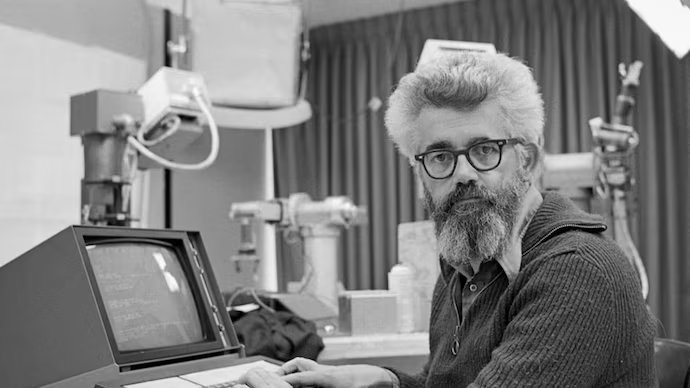

Artificial intelligence doesn’t have a single inventor the way a specific product might, but John McCarthy is widely credited as the founder of AI, having coined the term ‘artificial intelligence’ itself in 1956. Understanding who founded AI requires looking at a small group of researchers whose combined work in the 1940s and 1950s laid the foundation for the entire field.
John McCarthy: The Man Who Named the Field
John McCarthy, an American computer scientist, is most often called the father of AI because he coined the term ‘artificial intelligence’ in 1955 and organized the historic Dartmouth Summer Research Project on Artificial Intelligence in 1956, an event widely regarded as the formal birth of AI as an academic discipline. McCarthy later developed the Lisp programming language, which became foundational to early AI research, and made significant contributions to the theory of computation throughout his career at Stanford University.
The Dartmouth Conference: AI’s Official Starting Point
The 1956 Dartmouth Conference brought together a small group of researchers, including McCarthy, Marvin Minsky, Nathaniel Rochester, and Claude Shannon, to explore the idea that every aspect of learning and intelligence could in principle be precisely described and simulated by a machine. This eight-week workshop is considered the moment AI became a recognized field of study, even though the ambitious goals set at the conference took decades longer to achieve than the attendees initially expected.
Other Founding Figures in AI
Beyond McCarthy, several other researchers are considered founding figures of AI. Marvin Minsky co-founded the MIT AI Laboratory and made major contributions to neural networks and cognitive theory. Alan Turing, working even earlier in the 1930s and 1940s, laid essential theoretical groundwork with his concept of computation and the famous Turing Test, proposed in his 1950 paper ‘Computing Machinery and Intelligence,’ which is often cited as one of the earliest serious explorations of machine intelligence.
Early AI Programs and Milestones
Following the Dartmouth Conference, early AI pioneers built some of the first working AI programs, including the Logic Theorist by Allen Newell and Herbert Simon, often considered the first true AI program, capable of proving mathematical theorems. These early successes generated enormous optimism about AI’s potential, leading to significant government and academic funding throughout the late 1950s and 1960s.
Why There’s No Single Founder of AI
Unlike inventions with a clear single creator, AI emerged from the combined theoretical and practical work of multiple researchers across mathematics, computer science, neuroscience, and philosophy. While McCarthy is most commonly cited as the founder due to coining the term and organizing the founding conference, the field’s true origins trace back through Turing’s theoretical work and forward through the collaborative efforts of the Dartmouth attendees and their students.
AI’s Evolution From Founding Concepts to Today
From those founding concepts in the 1950s, AI has evolved through several boom-and-bust cycles, often called ‘AI winters,’ before the recent explosion of interest driven by deep learning, large language models, and generative AI tools starting in the 2010s and accelerating dramatically through the 2020s. The foundational ideas from McCarthy, Minsky, Turing, and their contemporaries remain directly relevant to how modern AI systems are designed, trained, and evaluated today.
Frequently Asked Questions
Who is officially called the father of AI? John McCarthy is most commonly given this title for coining the term and organizing the Dartmouth Conference in 1956. Did Alan Turing invent AI? Turing didn’t invent AI in the modern sense, but his theoretical work on computation and machine intelligence in the 1930s and 1940s laid essential groundwork that influenced the field’s later founders. What was the first AI program? The Logic Theorist, created by Allen Newell and Herbert Simon in 1955 to 1956, is widely considered the first true AI program.