
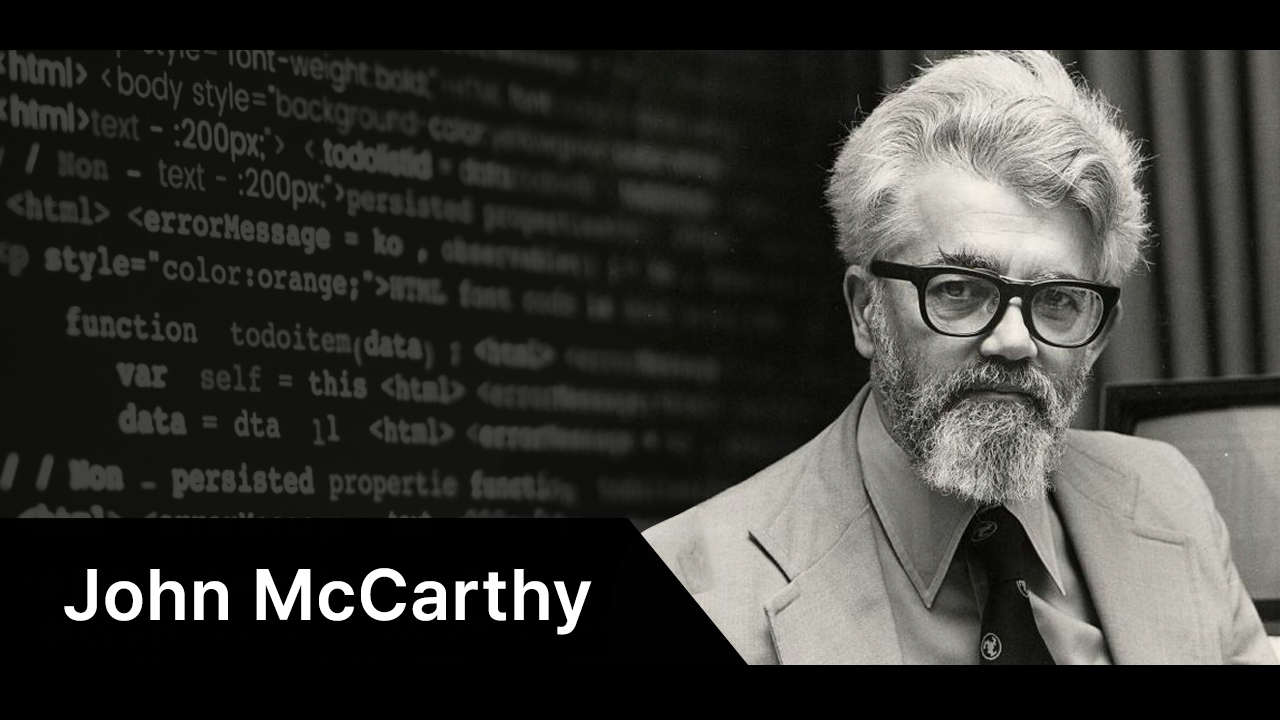

John McCarthy is most widely recognized as the founder of AI, having coined the term ‘artificial intelligence’ in 1955 and organized the influential 1956 Dartmouth Conference that formally established AI as a field of academic study. However, understanding who is truly the founder of AI requires looking beyond a single individual to the small group of researchers whose combined work shaped the discipline from its earliest days.
John McCarthy’s Defining Role
McCarthy, an American computer scientist working at Dartmouth College and later Stanford University, is credited with coining the phrase ‘artificial intelligence’ specifically to describe the ambitious new research area he was proposing. He organized the landmark 1956 Dartmouth Summer Research Project, bringing together a small group of researchers to explore whether machines could be made to simulate every aspect of human learning and intelligence.
The Dartmouth Conference and Its Attendees
The eight-week 1956 Dartmouth Conference is widely regarded as the official birthplace of AI as a formal academic discipline. Alongside McCarthy, key attendees included Marvin Minsky, Nathaniel Rochester, and Claude Shannon, each of whom brought different expertise in mathematics, computing, and information theory that collectively shaped the foundational goals and methods of early AI research.
Alan Turing’s Earlier Theoretical Contributions
While McCarthy is credited with founding AI as a named academic field, Alan Turing’s earlier theoretical work in the 1930s and 1940s, particularly his concept of computation and his influential 1950 paper proposing what became known as the Turing Test, laid essential intellectual groundwork that predates and directly influenced the Dartmouth Conference attendees.
Marvin Minsky’s Contributions
Marvin Minsky, another key Dartmouth Conference attendee, went on to co-found the MIT Artificial Intelligence Laboratory and made significant early contributions to neural network theory and cognitive science, helping establish MIT as one of the world’s leading centers for AI research throughout the following decades.
Why AI Doesn’t Have a Single Universally Agreed Founder
Because AI emerged from the combined theoretical and practical contributions of multiple researchers across different institutions and disciplines, there’s no single, universally agreed-upon founder in the way some inventions have one clear inventor. McCarthy is most commonly cited due to his role in naming the field and organizing its founding conference, but Turing, Minsky, Newell, Simon, and other early pioneers all made contributions considered essential to AI’s formal establishment.
Frequently Asked Questions
Is John McCarthy the only person credited with founding AI? No, while McCarthy coined the term and organized the founding conference, researchers like Alan Turing, Marvin Minsky, Allen Newell, and Herbert Simon are also widely recognized as key founding figures. What year is considered the official start of AI as a field? 1956 is widely cited as AI’s founding year, marking the Dartmouth Conference organized by McCarthy. What was the Dartmouth Conference’s original goal? It aimed to explore whether every aspect of learning and intelligence could be precisely described and simulated by a machine.
The Bottom Line
Asking who is the founder of AI ultimately leads to a small, tightly connected group of mid-twentieth-century researchers whose combined theoretical and practical work established artificial intelligence as a legitimate scientific field. While John McCarthy holds the most widely recognized claim to the title, understanding AI’s true founding requires appreciating the collaborative nature of its origins, a pattern that continues to define AI research today, decades after the field’s formal beginning.