
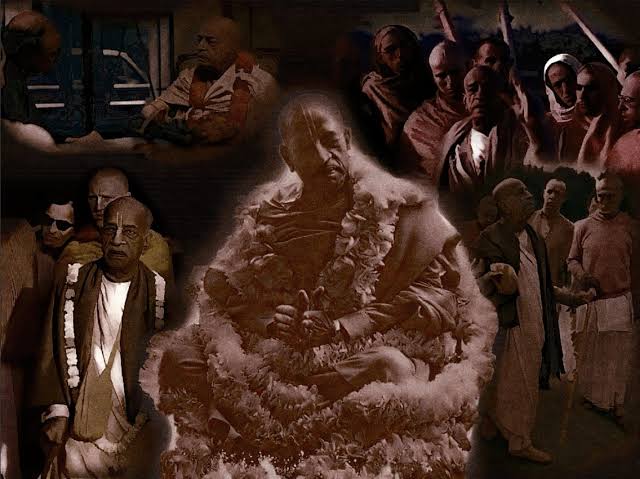

The International Society for Krishna Consciousness, widely known as ISKCON or the Hare Krishna movement, was founded in New York City in July 1966 by A.C. Bhaktivedanta Swami Prabhupada, an Indian spiritual teacher who traveled to the United States at the age of 69 specifically to spread the teachings of Gaudiya Vaishnavism, a devotional tradition centered on the worship of Krishna, to audiences in the West.
Prabhupada was born Abhay Charan De in Calcutta in 1896, and his path toward founding ISKCON reflects a life shaped significantly by his relationship with his spiritual teacher, Srila Bhaktisiddhanta Sarasvati Thakura, who instructed him early in their relationship to spread Krishna consciousness teachings to English-speaking audiences worldwide, an instruction that would ultimately shape the entire later trajectory of Prabhupada’s life and spiritual mission.
Before fully dedicating himself to this spiritual mission later in life, Prabhupada had pursued a career in business and had a family life in India, only later in life, after his children had grown, choosing to take up the life of a renunciant and dedicate himself more fully to religious study, writing, and eventually the international missionary work that would define his final decades.
Prabhupada’s journey to the United States in 1965, traveling by cargo ship with limited financial resources and carrying primarily his translated religious texts, represents one of the more remarkable aspects of ISKCON’s founding story, given the considerable personal hardship and uncertainty involved in an elderly religious teacher traveling alone to an unfamiliar country with the ambitious goal of establishing an entirely new religious movement among an audience with little prior exposure to the specific devotional tradition he represented.
After arriving in New York and facing initial hardship establishing himself, Prabhupada gradually attracted a following, particularly among young Americans who were part of the broader countercultural movement of the 1960s and who found genuine resonance in the devotional practices, chanting, and philosophical teachings he introduced, leading to the formal establishment of ISKCON as an organized religious institution in 1966.
The movement’s core practices, centered on the chanting of the Hare Krishna mantra, vegetarian diet, and devotional worship of Krishna, spread relatively quickly from its initial New York base to other American cities and subsequently to countries around the world, with Prabhupada personally traveling extensively during his remaining years to establish new temples and communities across multiple continents.
Prabhupada’s substantial body of translated and annotated religious texts, particularly his English translation and commentary on the Bhagavad Gita and the Bhagavata Purana, became foundational texts for the movement, providing English-speaking followers with direct access to core Gaudiya Vaishnava scriptural teachings that had previously been considerably less accessible to audiences outside India without knowledge of Sanskrit or Bengali.
ISKCON grew substantially in the decades following its founding, establishing temples, cultural centers, and educational institutions across dozens of countries, while also becoming known for its public chanting processions and its association with vegetarian food distribution programs, reflecting the movement’s broader emphasis on both spiritual practice and practical community service as core elements of its mission.
Prabhupada passed away in 1977, having established a governing body to oversee the movement’s continued leadership and expansion after his death, and ISKCON has continued operating as a significant global religious and cultural institution in the decades since, representing one of the more successful examples of an Indian spiritual tradition being formally established and sustained as an enduring international religious movement in the West.
His achievement is particularly notable given both his advanced age at the time of his journey to America and the genuinely modest resources he had available when he began, illustrating how a single individual’s sustained dedication, combined with substantial existing scriptural and philosophical groundwork from his own spiritual lineage, can result in the establishment of an enduring global religious institution within the span of just a single decade of active missionary work.